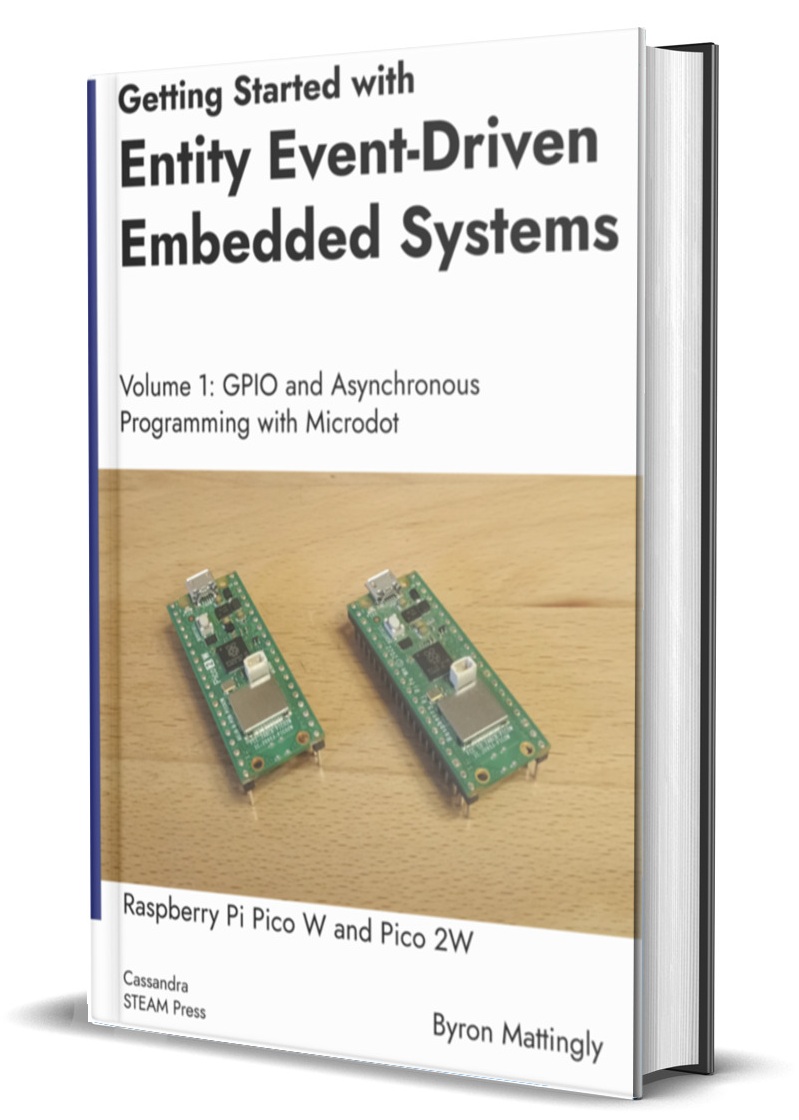
Book Description
This book is a streamlined but gentle introduction to the world of Entity Event-Driven Embedded Systems.
Using MicroPython, the Raspberry Pi Pico W and Pico 2W, makers, hobbyists, students and professionals can complete projects which are capable of participating in Event-Driven Architectures.
This practical step-by-step guide builds knowledge on creating Entity Event-Driven Embedded Pico Systems using MicroPython’s asyncio library and Microdot taking you from “Hello, world!” to interrupt driven concurrent systems.
It gets you started with using the Pico’s GPIO pins and WiFi by way of a few LEDs and asynchronous programming with Microdot, a remarkably small ultra-lightweight web server framework that’s even lighter(!) than Python Flask.
Learn by Doing Hands-On Examples
As you work through the examples in this guide, you will:
- Start writing MicroPython for your Pico using Thonny (or your favorite IDE)
- Become familiar with your Pico’s computational and machine-to-machine (M2M) capabilities using JSON
- Learn how to start connecting and controlling the physical world with your Pico’s pins
- Discover how to transform your wireless-enabled Pico into an Entity Event-Driven Embedded System with socket programming
- Transform your Pico into an Entity Event-Driven Embedded System using Microdot
- Implement concurrency on your Entity Event-Driven Embedded Pico Systems using asyncio’s and Microdot’s cooperative multitasking approach, improving responsiveness and efficient resource usage
Get Source Code Electronics Used
Who This Book Is For
The primary audience for this book are makers, hobbyists, students and professionals who want to learn more about Entity Event-Driven Embedded Systems using MicroPython’s asyncio library and Microdot.
It is assumed you know the basics of Python and have a host computer (a Raspberry Pi, Windows PC, or Apple mac), a Pico W or Pico 2W (these are available with the headers already soldered on), and some electronic components (such as a breadboard, LEDs, a button switch and Piezo buzzer).
About the Author
Byron Mattingly has been an embedded systems software engineer and hands-on technical manager for over 20 years in regulated development in the medical devices, pharmaceutical, and avionics industries. Currently his work is focused on designing and integrating complex IT systems and training and deploying AI/ML models interacting with embedded systems. An early adopter of the Raspberry Pi platform, he is an open source contributor and avid proponent of STEAM education.