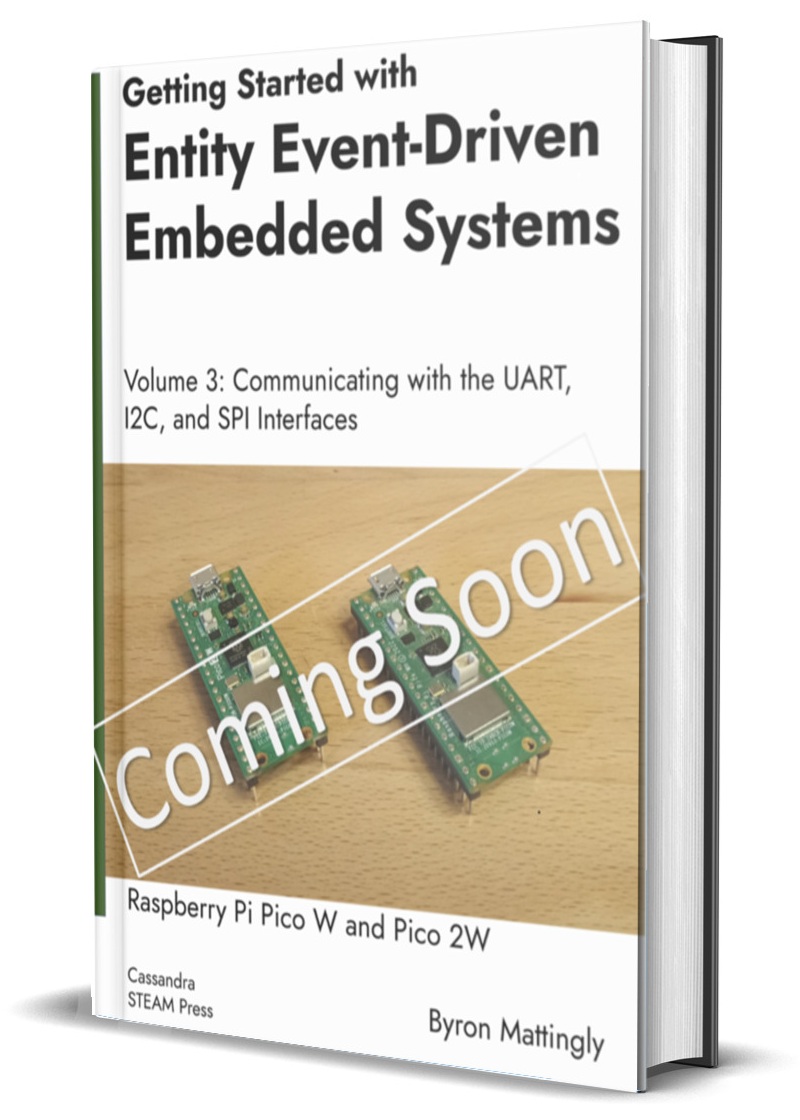
Expected Late Fall 2026:
Book Description
This book is an introduction to communicating with the UART, I2C, and SPI interfaces in Entity Event-Driven Embedded Systems.
Using MicroPython’s asyncio library and Microdot, makers, hobbyists, students, and professionals can provide microservices and other data consumers / AI Agents in Event-Driven Architectures with important, "real-time" telemetry from a wide array of external peripheral chips controlled by the Raspberry Pi Pico W or Pico 2W.
This practical and straightforward guide takes you from reading simple one-wire temperature sensors and communicating with legacy RS232 hardware via UART to managing high-speed data streams across multi-device I2C and SPI buses. It gets you started with decoding how digital information moves across physical wires by way of some of the most common, low-cost sensor and peripheral modules available today.
Learn by Doing Hands-On Examples
As you work through the step-by-step projects in this book, you will:
- Learn the strengths, limitations, and practical uses of UART, I2C, and SPI communication protocols
- Connect your Pico W or Pico 2W to a variety of real-world hardware, moving from one-wire temperature sensors and legacy RS232 devices to multiple I2C and SPI components sharing the same bus
- Discover how data moves between embedded systems and peripheral chips at the electrical and protocol level
- Build responsive sensor and device interfaces using MicroPython’s asyncio library
- Read and process device data streams without blocking your event loop
- Create asynchronous drivers that allow multiple hardware devices to communicate concurrently on a single Pico system
- Explore practical debugging techniques for diagnosing timing, wiring, and communication problems on breadboard prototypes
- Transform standalone hardware projects into responsive Entity Event-Driven Embedded Systems
Who This Book Is For
The primary audience for this book are makers, hobbyists, students and professionals who want to learn more about Entity Event-Driven Embedded Systems using MicroPython’s asyncio library and Microdot.
It is assumed you know the basics of Python and have a host computer (a Raspberry Pi, Windows PC, or Apple mac), a Pico W or Pico 2W (these are available with the headers already soldered on), and some electronic components (such as a breadboard, LEDs, a button switch and Piezo buzzer).
About the Author
Byron Mattingly has been an embedded systems software engineer and hands-on technical manager for over 20 years in regulated development in the medical devices, pharmaceutical, and avionics industries. Currently his work is focused on designing and integrating complex IT systems and training and deploying AI/ML models interacting with embedded systems. An early adopter of the Raspberry Pi platform, he is an open source contributor and avid proponent of STEAM education.